Presbyopia is an age-related condition that occurs when the eye cannot focus clearly, making close-up objects look blurred.
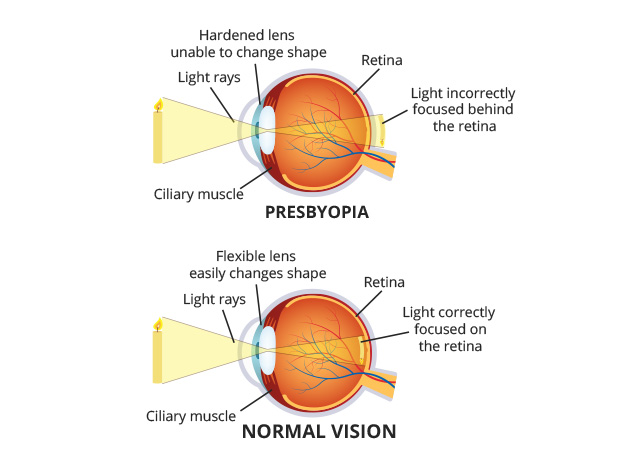
In young eyes, the lens inside the eye is flexible. It easily changes shape with the help of a circular muscle around it, called the ciliary muscle. This helps the eye focus on close-up objects.
Presbyopia happens when the lens inside the eye hardens and loses its flexibility. This makes it more difficult for the ciliary muscle to change the shape of the lens to correctly focus light on the retina, a layer of tissue in the back of the eye. This incorrectly focused light causes blurry vision.
Presbyopia happens naturally with age. It usually begins around age 40, even for people who have never experienced vision problems in the past.
Presbyopia is an age-related condition that occurs when the eye cannot focus clearly, making close-up objects look blurred.
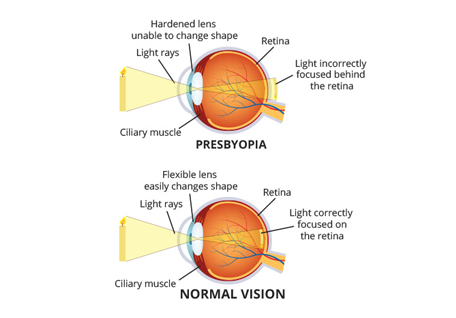
In young eyes, the lens inside the eye is flexible. It easily changes shape with the help of a circular muscle around it, called the ciliary muscle. This helps the eye focus on close-up objects.
Presbyopia happens when the lens inside the eye hardens and loses its flexibility. This makes it more difficult for the ciliary muscle to change the shape of the lens to correctly focus light on the retina, a layer of tissue in the back of the eye. This incorrectly focused light causes blurry vision.
Presbyopia happens naturally with age. It usually begins around age 40, even for people who have never experienced vision problems in the past.
Contact lenses are an easy and convenient treatment option for presbyopia—even for those who also have astigmatism!
The website you are about to visit is not affiliated with Bausch + Lomb Incorporated. Bausch + Lomb is not responsible for the content, format, maintenance, or policies of the website you are about to enter and does not monitor non-affiliated websites for accuracy. Links to non-affiliated websites are provided as a convenience; they do not constitute an endorsement or support of any programs, products, or services associated with the website.